
August 10, 2026
Scintillon Institute and University of Pittsburgh Scientists Receive $981,365 from the NIH for Redox Metabolism Research
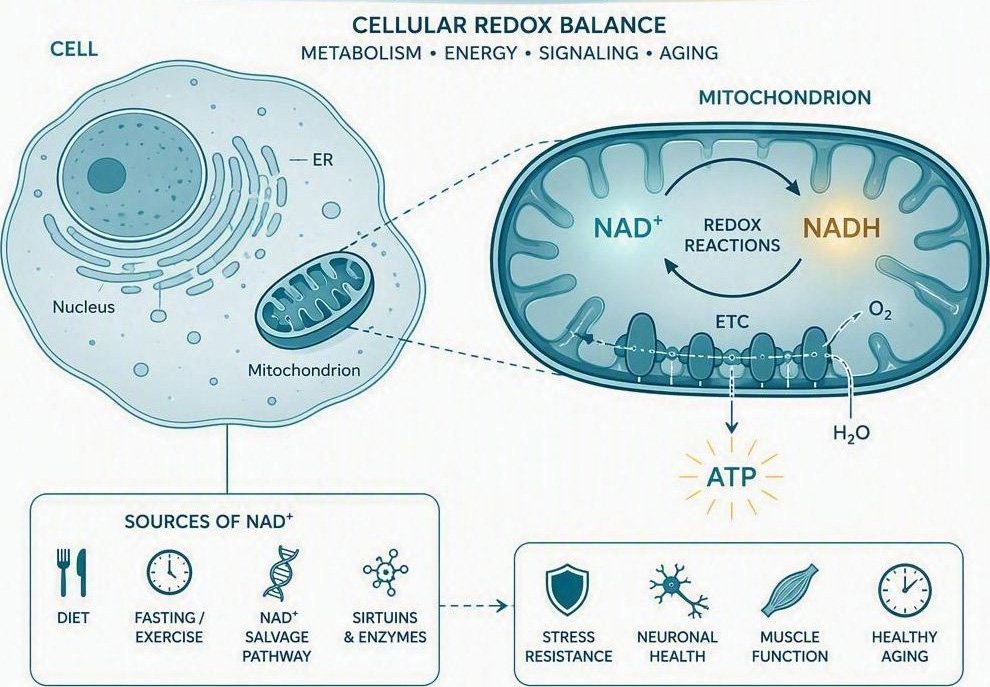
SAN DIEGO - Scintillon Institute investigator Dr. Valentin Cracan and University of Pittsburgh Aging Institute researcher Dr. Andrey Parkhitko have been awarded two exploratory R21 grants from the National Institutes of Health, totaling $981,365, to determine how redox metabolism shapes aging and cancer and whether modulating it can delay both. Both scientists serve as principal investigators on each project.
Redox dysregulation, defined as an imbalance in the ratio of NAD⁺ (nicotinamide adenine dinucleotide, oxidized form) to NADH (its reduced form), is implicated in aging and in the metabolic remodeling of cancer, alongside a parallel imbalance in the phosphorylated cofactor pair NADP⁺ and NADPH. Whether these shifts drive disease or simply accompany them has remained difficult to determine because the enzymes that establish these ratios exist as redundant isoforms and often perform additional, unrelated cellular functions.
The two laboratories take a creative approach: adding novel metabolic enzymes instead of manipulating endogenous ones. Xenotopic enzymes derived from microbes and other lower organisms, which have no counterparts in animal cells, can reset a specific redox cofactor ratio directly while leaving the surrounding metabolic network largely intact. Combined with powerful Drosophila genetics, these xenotopic enzymes can be expressed in muscle but not neurons, or in the cytosol but not the mitochondrion, allowing researchers to precisely define tissue and compartment as experimental variables.
“These awards support an innovative strategy for answering one of the most important questions in metabolism and disease: whether disruptions in cellular redox balance are a cause of aging and cancer or a consequence of them,” said Dr. Jiwu Wang, Scientific Director, CEO, and Professor at Scintillon Institute. “By combining novel metabolic engineering tools with powerful genetic models, Drs. Cracan and Parkhitko are creating a platform that could open new avenues for developing therapies to target aging, cancer, and other diseases linked to age-associated metabolic decline, a focus of Scintillon’s translational research and industry-oriented partnership.”
Two NIH R21 grants will support the following projects:
Aging (R21AG101323, National Institute on Aging). Flies expressing the xenotopic tool, the water-forming NADH oxidase LbNOX, live longer, withstand oxidative stress, and retain neuromuscular function and sleep quality with age. Location mattered as much as the intervention itself: LbNOX expression in muscle protected against paraquat-induced oxidative stress far more effectively than expression throughout the body or in neurons. The award will identify which tissues are responsible for these benefits and test whether they depend on NAD kinase, an enzyme which converts NAD⁺ into NADP⁺.
Cancer (R21CA313483, National Cancer Institute). Testing every enzyme, compartment, and combination is beyond what mouse studies can realistically accommodate, so the teams developed a Drosophila cancer model that measures tumor growth and survival at a semi-high-throughput scale. The award will generate organelle-specific versions of the redox toolkit and screen combinations of pro-reductive and pro-oxidative states across cellular compartments, testing whether tumors depend on particular redox configurations linked to NAD(P) metabolism and whether disrupting those configurations abolishes cancer growth.
“Drosophila has been widely used for modeling cancer and developing cancer therapeutics because of its extraordinary evolutionary conservation and the availability of techniques for manipulating the fly genome. This has led to the use of Drosophila as an avatar for human cancers,” said Dr. Andrey Parkhitko.
Together, the awards establish a platform for determining whether redox pathways lie upstream of disease processes or merely accompany them, providing a powerful new framework for investigating the metabolic basis of aging and cancer.
You can read more about the research in the Cracan lab at: https://cracanlab.com/