
August 10, 2026
New RNA-based Gene Therapy Targeting microRNA-23b Restores Blood-Brain Barrier Integrity and Improves Stroke Outcomes
Preclinical research demonstrates that targeted neutralization of miR-23b strengthens blood-brain barrier (BBB) function, accelerates repair, and reduces ischemic injury in stroke models.
In a recent issue of Advanced Science, Prof. Irene Munk Pedersen from Scintillon Research Institute with colleagues at Columbia University Medical Center published an article titled: “Modulation of miR-23b Wnt/β-catenin Axis Strengthens Endothelial Barrier Properties”
Neurological disorders with a dominant vascular component, such as stroke and Alzheimer's disease, impose a profound healthcare burden. These conditions feature heterogeneous pathobiology, driven by diverse risk factors that frequently stem from blood-brain barrier (BBB) impairment. Early BBB disruption is a critical factor driving poor prognosis and is recognized to predict cognitive impairment and dementia. As a major risk factor, aging further compounds this issue through pre-existing BBB dysfunction.
In this manuscript, Dr. Pedersen and colleagues identified a novel role for miR-23b as a master regulator of brain endothelial cells and BBB function. Employing a non-biased anti-miR lentiviral screening strategy, leveraging gain- and loss-of-function approaches and multi-omics analysis this study revealed the mechanisms by which anti-miR-23b/miR-23b regulates BBB function in healthy versus ischemic stroke conditions, using 3D microfluidic culture platforms, validated in an in vivo mouse model for stroke (t-MCAo), demonstrating that anti-miR-23b enhances BBB properties by regulating junctional proteins, transcytosis, and key signaling pathways in brain endothelium, most notably Wnt/β-catenin, TGF-β and VEGF. By improving BBB integrity, this approach significantly ameliorates outcomes in ischemic stroke models. These findings have high physiological and clinical relevance, positioning miR inhibitors as promising therapeutic agents for CNS diseases with a BBB deficit disease component including (stroke, TBI, Alzheimer’s, Parkinson’s, MS, NeuroHIV and PANDAS).
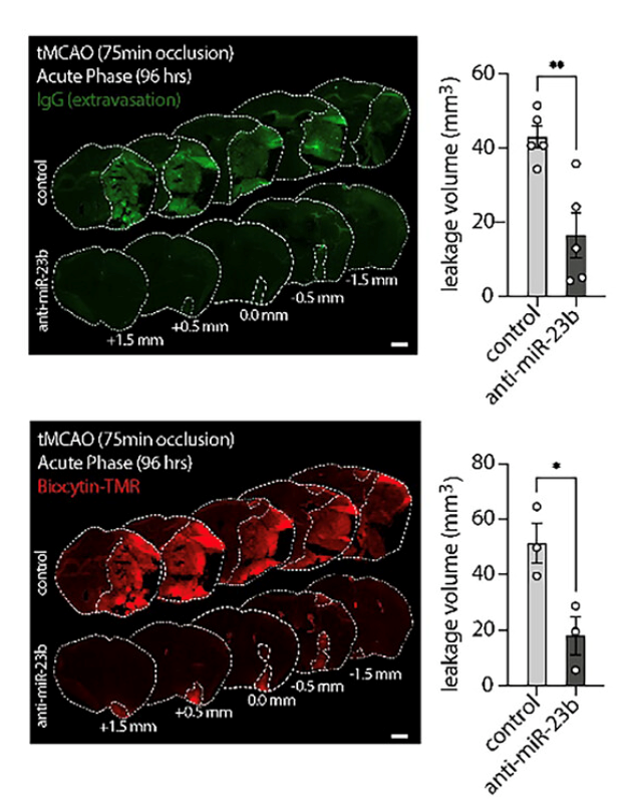
Anti-miR-23b AAV-BR1 stroke gene therapy